

Author: Shah Jahan Ahmad, MSc Social Research
We all know the feeling. You tear the plastic off a brand-new smartphone, lift the pristine lid of the box and hold that sleek, perfectly polished piece of glass and metal in your hand. It’s faster, the camera is sharper, and the battery actually lasts all day. But in that moment of consumer joy, a crucial question is almost never asked: What happens to the old one?
Maybe it gets shoved into the infamous “junk drawer” alongside tangled cords from 2012 and keys to unknown doors. Maybe you drop it in a recycling bin, hoping for the best. Or maybe, like millions of devices every single day, it ends up in a landfill.
I looked at the data to understand the real lifespan of our devices, trying to find a way out of the e-waste crisis we have built for ourselves. We have to completely change how we buy and use our gadgets, and I am hoping exploring this topic can help point us in the right direction.

The “Take-Make-Dispose” Trap
For the past century, the global economy has operated on a linear model which is the ‘Take, Make, Dispose’. We extract raw materials from the earth, manufacture them into products, use them for a fraction of their potential lifespan, and then throw them away.
Basically, we are acting like the Earth has an endless supply of materials, but it does not. Nowhere is this more devastatingly clear than in the tech industry. The world generated a staggering 62 million metric tonnes of e-waste in 2022. To put that data into perspective, that is equivalent to 1.55 million fully loaded 40-tonne trucks enough to form a bumper-to-bumper line wrapping entirely around the equator. Furthermore, data shows that only a dismal 22.3% of this massive volume was officially documented as properly collected and recycled, meaning over three-quarters of our discarded technology is simply lost to dumps, incinerators, or substandard processing. We are generating this waste at a pace that is five times faster than our capacity to recycle it.
Why is this happening? Part of it is our constant craving for the “next big thing,” fueled by brilliant marketing. But a larger, more insidious part of the problem is planned obsolescence. The devices are deliberately designed to fail, become outdated, or become impossible to repair after a certain period. When a manufacturer glues a battery into a smartphone so tightly that replacing it destroys the screen, they are not just making a design choice; in fact, they are making a waste choice.
Beyond the Landfill: The Human and Environmental Toll
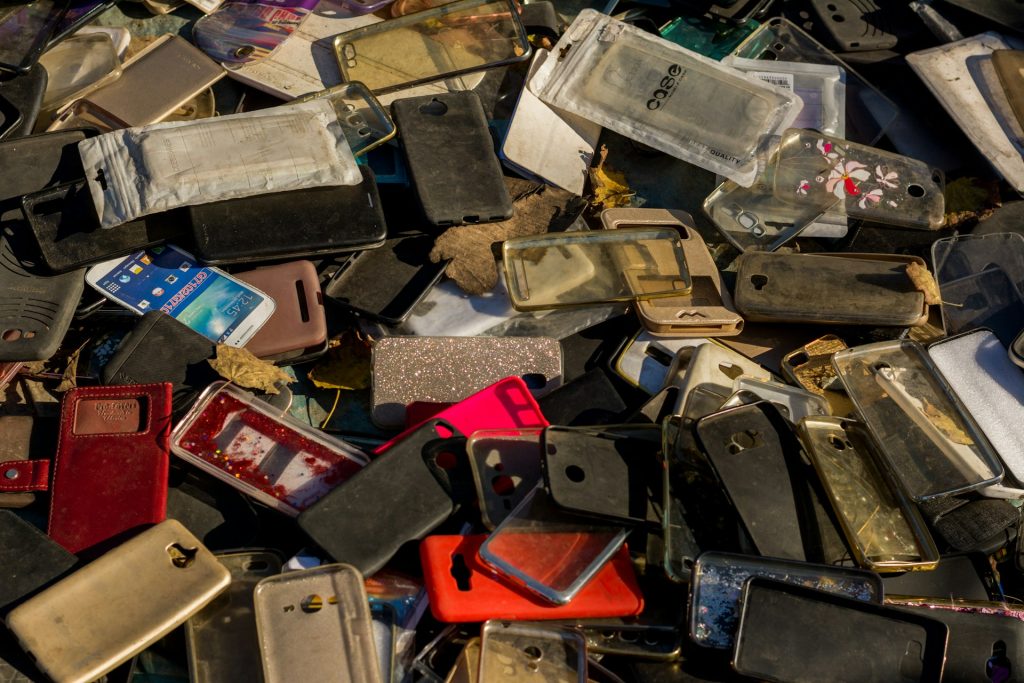
The Carbon Cost: Did you know that roughly 80% to 90% of a smartphone’s total lifetime carbon footprint is generated before you even take it out of the box? The energy required to mine the metals, refine them, manufacture the microchips, and ship the device globally is astronomical. When we throw away a phone after two years, we are throwing away all that embedded energy.
Then there is the human cost of extraction. The cobalt in your lithium-ion battery likely came from the Democratic Republic of Congo, where severe human rights abuses and unsafe labor practices in artisanal mines are well-documented by Amnesty International. The lithium may have been pumped from beneath the arid salt flats of the Andes, draining precious water resources from local Indigenous communities.
When devices reach their end-of-life, the injustice continues. Instead of dealing with our own mess, wealthier countries end up shipping a huge chunk of our e-waste, sometimes legally, often not to the developing world. In places that have basically become global dumping grounds, like Agbogbloshie in Ghana or Guiyu in China, people have set up dangerous makeshift recycling yards. It is a massive crisis that environmental groups have been tracking for years. Here workers who are often children, dismantle toxic electronics by hand. They burn the plastic casings off copper wires in open fires, releasing highly toxic dioxins and heavy metals like lead and mercury into the air, soil, and water.
This is not just an environmental issue; it is a profound issue of global environmental justice.
The Antidote: Enter the Circular Economy
To fix this, we need to shift to a Circular Economy. This global shift is built on three core principles:
- Eliminate waste and pollution by design: Building things to last, making them modular so parts can be swapped, and using non-toxic materials.
- Circulate products and materials at their highest value: Prioritizing repair, refurbishment, and reuse over recycling. Recycling should be the absolute last resort.
- Regenerate nature: Moving away from fossil fuels and extractive practices toward renewable energy.
Think about it: what if you did not actually buy your washing machine? What if you just rented the service of getting your clothes clean? If the manufacturer still owns the hardware, it is totally in their best interest to make sure it never breaks, is super easy to fix, and can be stripped for parts when it finally dies.
Turning Data into Action
Making this shift requires bridging a massive global information gap. Currently, once a product leaves a factory, it disappears into a black hole of consumption. That is where emerging academic and structural research comes in. When a laptop ends up in a recycling facility in Berlin, the recyclers have no idea what exact alloys are in the motherboard, or how to safely dismantle the specific battery used in that model. Without data, efficient recycling and reuse are impossible.
Current innovations focus on building “Digital Product Passports” (DPPs) and predictive resource models. Right now, regulators are pushing this DPP idea hard through their Ecodesign rules.The goal is essentially to give every single item we manufacture its own secure, digital life story that lives in the cloud. By leveraging database technologies and machine learning, we can create a digital twin of a device. If you scan a QR code on the back of a future smartphone, you (and a recycler) could instantly see:
- Exactly where the cobalt and lithium were mined.
- The carbon footprint of its manufacturing.
- A 3D schematic showing how to safely disassemble it.
- The exact chemical composition of its plastics.
But the industry doesn’t just track things it tries to look ahead. By digging into past trends and how people actually buy stuff, data models can figure out exactly when and where these materials are going to get tossed out. Let’s say a massive company decides to swap out all its old servers. A predictive system can flag that sudden wave of valuable copper and silicon about to hit the local scrap market. From there, it plays matchmaker connecting that exact pile of ‘trash’ with a company desperate for those specific raw materials. It’s basically Tinder for industrial waste.
Global Solutions, Local Actions
Moving to a circular economy is not just wishful thinking anymore. It is actually happening right now, mostly because new laws are forcing the issue and everyday buyers are starting to demand better.
A step is being taken by the European Union leading the charge. They have introduced legislation mandating the use of USB-C chargers across all devices to drastically reduce cable waste, and they are actively implementing Right to Repair directives that force manufacturers to provide spare parts and manuals to independent repair shops and consumers
The concept of Extended Producer Responsibility (EPR) is gaining global traction. EPR laws will make the manufacturer financially and physically responsible for the entire lifecycle of their product, including its end-of-life disposal. So when a company has to pay to clean up their own mess, they suddenly figure out how to design products that do not make a mess in the first place.
But we cannot wait and rely only on governments and corporations to act alone. As individuals, our economic choices are the ultimate steering wheel of the global market. Here is how you can directly participate in the circular revolution:
- Embrace the “Right to Repair”: Before throwing out a sluggish laptop, look for a local repair café. Websites offer free, step-by-step repair guides for thousands of devices, such as iFixit.
- Vote with your wallet: Choose companies that prioritize longevity and repairability. Look into brands which design modular, easily repairable smartphones using ethically sourced minerals, like Fairphone.
- Buy Refurbished: The stigma around “used” technology needs to die. Buying a professionally refurbished device saves massive amounts of carbon and keeps money in your pocket.
- Hold on longer: The most sustainable phone in the world is the one you already own. Keeping a device for three or four years instead of two halves its lifetime environmental impact.
- Recycle responsibly: When a device is truly dead, do not put it in the household trash. Seek out certified e-waste recyclers who adhere to strict standards (such as R2 Certification), guaranteeing your device will not be shipped overseas to an informal dump.
By making these choices, we can stop treating our technology as disposable trash and start treating it as a valuable, temporary collection of the Earth’s borrowed materials.
References
Amnesty International (2016) ‘This is What We Die For’: Human Rights Abuses in the Democratic Republic of the Congo Power the Global Trade in Cobalt. London: Amnesty International. Available at: https://www.amnesty.org/en/documents/afr62/3183/2016/en/ (Accessed: 18 May 2026).
Basel Action Network (2018) Holes in the Circular Economy: WEEE Leakage from Europe. Seattle: BAN. Available at: https://www.ban.org/trash-transparency (Accessed: 18 May 2026).
Belkhir, L. and Elmeligi, A. (2018) ‘Assessing ICT global emissions footprint: Trends to 2040 & recommendations’, Journal of Cleaner Production, 177, pp. 448-463. Available at: https://doi.org/10.1016/j.jclepro.2017.12.239 (Accessed: 18 May 2026).
Ellen MacArthur Foundation (no date) What is a circular economy? Available at: https://www.ellenmacarthurfoundation.org/circular-economy/concept (Accessed: 18 May 2026).
European Commission (2024) Ecodesign for Sustainable Products Regulation. Available at: https://environment.ec.europa.eu/news/sustainable-products-be-norm-consumers-new-regulation-2024-07-19_en (Accessed: 18 May 2026).
European Commission (2024) Directive on common rules promoting the repair of goods. Available at: https://commission.europa.eu/law/law-topic/consumer-protection-law/directive-repair-goods_en (Accessed: 18 May 2026).
European Parliament (2022) Long-awaited common charger for mobile devices will be a reality in 2024. Press Release. Available at: https://www.europarl.europa.eu/news/en/press-room/20220930IPR41928/long-awaited-common-charger-for-mobile-devices-will-be-a-reality-in-2024 (Accessed: 18 May 2026).
Fairphone (no date) Our Mission: A fairer electronics industry. Available at: https://www.fairphone.com/ (Accessed: 18 May 2026).
Geissdoerfer, M., Savaget, P., Bocken, N.M. and Hultink, E.J. (2017) ‘The Circular Economy – A new sustainability paradigm?’, Journal of Cleaner Production, 143, pp. 757-768. Available at: https://doi.org/10.1016/j.jclepro.2016.12.048 (Accessed: 18 May 2026).
iFixit (no date) The Free Repair Manual. Available at: https://www.ifixit.com/ (Accessed: 18 May 2026).
Pexels (no date) A hand fixing an electronic device using screwdriver. Available at: https://www.pexels.com/photo/a-hand-fixing-an-electronic-device-using-screwdriver-6755075/ (Accessed: 18 May 2026).
Pexels (no date) Cellphone and wire in box. Available at: https://www.pexels.com/photo/cellphone-and-wire-in-box-13570128/ (Accessed: 18 May 2026).
Pexels (no date) Pile of electronic waste. Available at: https://www.pexels.com/photo/pile-of-electronic-waste-19037726/ (Accessed: 18 May 2026).
Sustainable Electronics Recycling International (SERI) (no date) R2 Standard. Available at: https://sustainableelectronics.org/ (Accessed: 18 May 2026).
UNITAR, ITU and ISWA (2024) The Global E-waste Monitor 2024. Geneva: United Nations Institute for Training and Research. Available at: https://ewastemonitor.info/the-global-e-waste-monitor-2024/ (Accessed: 18 May 2026).