

Policy Brief
Author: Ndukuba Justice Umeh, MSc Social Research, cohort 2025/26
Executive Summary
UK immigration policy increasingly links the control of irregular immigration with broader efforts to reduce migration overall. Legislative frameworks have shaped enforcement mechanisms across different migration routes including Immigration Acts (1971, 2014, 2016), and the Illegal Migration Act 2023. International students, who enter the UK under the Student Route in Appendix Student of the Immigration Rules, are subject to tightly regulated visa system but remain affected by stricter migration policy. Evidence suggests that contradictions exist between the policy on irregular migration and the governance of student migration within the UK. The Office for National Statistics (2023) found that the majority of students depart the UK after completing their studies. International students make a significant economic contribution, both through tuition fees and wider spending while studying. Universities have increasingly become immigration compliance actor, creating institutional tension in the governance of higher education. It is recommended that policies for regulating irregular migration be separated from those governing international students. Migration statistics should be improved to distinguish between temporary educational mobility and permanent migration. Graduate Route visa should be retained to support the continued contribution of skilled graduates to the UK economy. Immigration governance should be aligned with SDG 16 principle of transparency, accountability, and evidence-based policymaking.

Introduction
Migration governance is one of the most politically sensitive areas of public policy in the United Kingdom (Benson & Sigona, 2024). Policy debates increasingly focus on irregular migration and border control, yet strategies to combat illegal migration have increasingly intersected with legal migration routes, especially those involving international students. Zotti (2020) argues that immigration governance sometimes combines security and economic migration management, resulting in restrictive frameworks that govern different migration groups under the same policy logic. The UK student visa policy is complex; Liu (2024) explains that the student route under the UK immigration requires institutional sponsorship, evidence of financial capacity, and compliance with visa conditions. Despite this regulated system, international students have become caught up in broader migration reduction agendas. Vari‐Lavoisier (2025) notes that most student migrates for educational purpose rather than long term settlement. Beyond migration control, these policies raise concerns about institutional transparency and governance This governance challenge align with Sustainable Development Goal 16 particularly 16.6, which emphasises the development of effective, accountable and transparent institutions. International students contribute more than 41.9 billion pounds annually to the UK economy and support labour market and regional development, (Universities UK, 2023).
Methodology
This policy brief adopts an evidence-based approach that combines legislative review, policy analysis, and secondary research to examine the factors shaping migration policy and the role of systematic analysis. This brief examines key development in UK immigration policy, including the Immigration Acts of 1971, 2014 and 2016 as well as the Illegal Migration Act 2023. It also analyses the Student Route visa under the Immigration Rules drawing on credible sources and incorporating SDG16 principle of transparent and accountable governance.
Research Findings and Conclusions
The development of UK immigration policy shows an increasingly close alignment between control of irregular migration and the regulation of legal migration. The Immigration Act 1971 laid the legal basis of contemporary immigration control, granting the government the power to control entry, residence and deportation (Morris, 2024). While the Act established the basic structure of immigration control, subsequent legislative changes expanded the range of enforcement measures.
The Immigration Act 2014, introduced the ‘hostile environment’ policy which sought to disrupt irregular migration by introducing immigration checks into every everyday service such as housing, employment, and financial services (UK Visas and Immigration, 2016).
The Immigration Act 2016 went further by tightening immigration enforcement through criminal penalties for illegal working and expanded information sharing mechanisms between government agencies (Fudge, 2018). Cassidy and Davidson (2024) observe that the role of licence sponsors further integrated universities into immigration compliance systems because of attendance monitoring and reporting requirements
More recently, the UK position on irregular migration has become more restrictive under the Illegal Migration Act 2023, which introduced stronger enforcement powers, including detention, and restriction, on asylum claims (Gower et al., 2023; Home Office, 2023). Biswas (2025) argues that, although the legislation is geopolitically focused on unlawful border crossing, the broader political framing of the issues may shape public perception of migration more generally.
In this policy environment, strategies to reduce migration have increasingly affected international students. The UK has a Points Based Immigration System, that operates within the Immigration Rules and regulates international students through the Student Route visa frame work administered by the Home Office (Gower 2020; GOV.UK, 2022).
Policy changes introduced by the Home Office in January 2024 restricted the number of international students eligible to include dependants in their visa application, except for postgraduate research students (Behnamfar, 2024). However, such restrictions may make the UK a less attractive destination for international scholars.
These findings suggest that applying irregular migration control measures to international student policy is unlikely to address the underlying drivers of illegal migration. From a governance perspective, such policy overlaps risks weakening institutional clarity and undermining regulatory transparency.
Sustainable Development Goal 16 emphasises that effective institution requires that effective institution requires legal frameworks and transparent policy making and governance processes (United Nations, 2025). When immigration policies conflate irregular migration control with legal educational mobility, institutional credibility might be undermined and policy outcomes may become less effective.
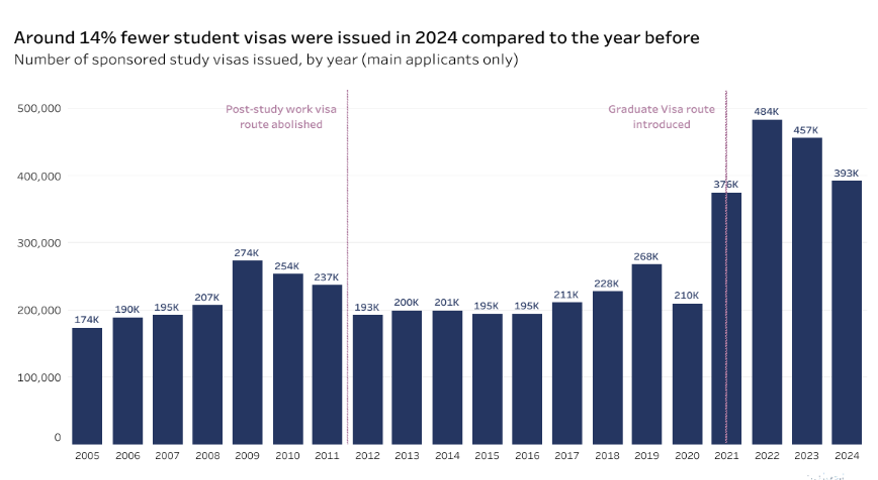
Figure 1: Number of study visa issued by year (Source: Migration Observatory of Home Office Immigration Statistics).
Evidence and Policy Analysis
Evidence suggests that contradictions exist between policies on irregular migration and the governance of students’ migration in the UK. ONS (2023) and the Migration Statistics team (2024) indicate that international students make up a significant share of net migration statistic; However, the majority leave after completing their studies. Despite this, migration reduction policies often target students because they are highly visible in the migration statistics.
Economically, international students generate substantial financial benefits through tuition fees and wider spending for example, in 2023-2024, international tuition fees totalled £12.1 billion (Ukehajdaraj, 2026). Meanwhile, the sponsorship system obliges universities monitor student compliance, effectively turning universities into immigration enforcement institution and placing significant institutional burden on them (Tiernan, 2025). These dynamics reveal a major policy dilemma: limiting students’ mobility may undermine UK education sector without effectively addressing irregular migration.
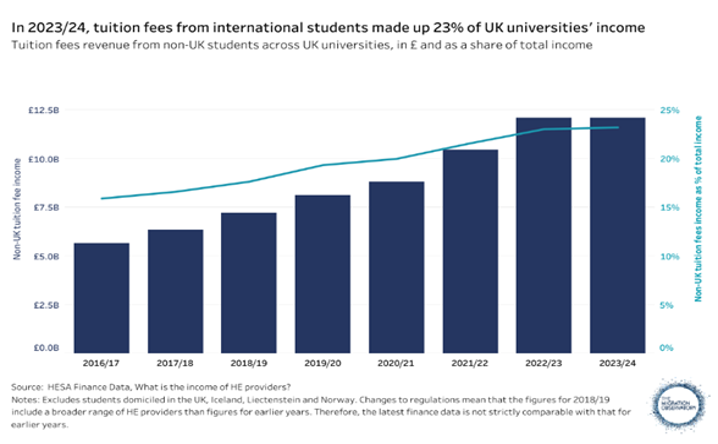
Figure 2 Tuition fees revenue from non UK students across UK universities (Source: HESA Finance Data)
Policy Implications and Recommendations
A number of important policy implications can be drawn from this analysis.
Immigration governance should draw a clearer distinction between enforcement targeting irregular migration and the regulation of international students. This would improve statistical transparency and reduce political pressure on student visa policies.
The Graduate Route visa introduced in 2021 should be retained as a strategic mechanism for retaining international skilled graduates who contributes to the UK labour market.
Immigration governance should integrate SDG 16 principles, particularly transparency, accountability and evidence-based decision making
Separating irregular migration enforcement from international student would enhance institutional transparency and regulatory coherence, supporting the good governance principles of Sustainable Development Goal 16.
Implications of Policy Recommendations
Following these recommendations would yield a number of wider policy benefits.
- Improved regulatory clarity would help immigration enforcement efforts focus directly on the irregular migration routes.
- Protecting international student mobility would increase the financial viability of UK universities and contribute to regional economic development.
- Maintenance of the Graduate Route would respond to labour market demands in the sectors in which there is a skills shortage.
- Conjoining the governance of immigration to institutional principles contained in the SDG 16 would strengthen transparency, accountability and policy legitimacy
- Clearer policy separation between legal and illegal categories of migration would increase the credibility of UK immigration governance both at the national and international levels.
Conclusion
UK immigration policy has increasingly focused on reducing irregular migration through laws such as the Immigration Acts of 1971, 2014 and 2016, also Illegal Migration Act 2023.
However, international students remain a highly regulated and economically valuable group with strong compliance rates. Conflating the control of irregular migration with student regulation risks weakening governance and competitiveness of higher education. Policy coherence grounded in SDG16 principle of transparency and accountability, supports clearer policy separation and underpins effective and equitable migration governance.
References
Behnamfar, N. (2024) Changes to the UK Student Visa Rules For Dependants Richmond Chambers. Available online: https://immigrationbarrister.co.uk/changes-to-the-uk-student-visa-rules-for-dependants/.
Benson, M. & Sigona, N. (2024) Reimagining, Repositioning, Rebordering: Intersections of the Biopolitical and Geopolitical in the UK’s Post-Brexit Migration Regime (and Why It Matters for Migration Research). International Migration Review, 58(4). Available online: https://doi.org/10.1177/01979183241275457.
Biswas, D. (2025) Wl-4122-Borders Know Best: Technologised Borders and Discriminatory Migration Practices. Economic & Political Weekly, 60(24). Available online: https://doi.org/10.71279/epw.v60i24.39406.
Cassidy, K. & Davidson, G. (2024) Bordering public institutions through the routinization of borderwork and datafication: Internalized immigration regimes within UK health care and higher education. Environment and Planning. D, Society and Space/Environment and Planning. D, Society & Space, 42(2). Available online: https://doi.org/10.1177/02637758241233898.
Fudge, J. (2018) Illegal Working, Migrants and Labour Exploitation in the UK. Oxford Journal of Legal Studies, 38(3), 557–584. Available online: https://doi.org/10.1093/ojls/gqy019.
GOV.UK (2022) The UK’s points-based Immigration system: an Introduction for Employers GOV.UK. Available online: https://www.gov.uk/government/publications/uk-points-based-immigration-system-employer-information/the-uks-points-based-immigration-system-an-introduction-for-employers.
Gower, M. (2020) The new points-based immigration system Contents. CBP, 8911. Available online: https://researchbriefings.files.parliament.uk/documents/CBP-8911/CBP-8911.pdf.
Gower, M., Mckinney, C., Dawson, J. & Foster, D. (2023) Illegal Migration Bill 2022-23. Available online: https://researchbriefings.files.parliament.uk/documents/CBP-9747/CBP-9747.pdf [Accessed 13/March/2026].
Home Office (2023) Illegal Migration Act 2023 GOV.UK. Available online: https://www.gov.uk/government/collections/illegal-migration-bill.
Liu, W. (2024) The Impact of Visa Policy on Higher Education International Students. Journal of Education, Humanities and Social Sciences, 26, 92–99. Available online: https://doi.org/10.54097/0bkyjg13.
Migration Statistics team (2024) Reason for international migration, international students update Ons.gov.uk. Office for National Statistics. Available online: https://www.ons.gov.uk/peoplepopulationandcommunity/populationandmigration/internationalmigration/articles/reasonforinternationalmigrationinternationalstudentsupdate/november2024.
Morris, A. (2024) The Immigration Act 1971: A Guide | DavidsonMorris Davidson Morris. Available online: https://www.davidsonmorris.com/immigration-act-1971/.
ONS (2023) Reason for international migration, international students update – Office for National StatisticsWww.ons.gov.uk. Available online: https://www.ons.gov.uk/peoplepopulationandcommunity/populationandmigration/internationalmigration/articles/reasonforinternationalmigrationinternationalstudentsupdate/november2023.
Tiernan, A. (2025) Higher Education Spaces as Immigration Sites: A Critical Examination. Available online: https://doi.org/10.1007/978-3-031-75140-0_10.
UK Visas and Immigration (2016) Immigration Act: overview GOV.UK. Available online: https://www.gov.uk/government/publications/immigration-bill-2015-overarching-documents/immigration-bill-201516-overview-factsheet.
Ukehajdaraj, G. (2026) International Student Statistics in UK 2023 – Study in UK Study in UK. Available online: https://studying-in-uk.org/international-student-statistics-in-uk/.
United Nations (2025) Peace, justice and strong institutions United Nations Sustainable Development. United Nations. Available online: https://www.un.org/sustainabledevelopment/peace-justice/.
Universities UK (2023) International students boost UK economy by £41.9 billion Universities UK. Available online: https://www.universitiesuk.ac.uk/latest/news/international-students-boost-uk-economy.
Vari‐Lavoisier, I. (2025) Financing the Future: The Contribution of Scholarship and Self‐Funded International Students to Short‐ and Long‐Term Migration to the UK. International Migration, 63(5). Available online: https://doi.org/10.1111/imig.70089.
Zotti, A. (2020) The Immigration Policy of The United Kingdom: British Exceptionalism and the Renewed Quest for Control. The European Union in International Affairs, 57–88. Available online: https://doi.org/10.1007/978-3-030-53997-9_3.